41 moss life cycle diagram
A moss begins its life cycle when haploid spores are released from a sporophyte capsule and begin to germinate. In the majority of mosses, germination is exosporic, i.e., the spore wall is ruptured by the expanding spore protoplast after its release from the capsule and prior to any cell division. However, in some mosses, e.g., Moss life cycle. Diagram of a life cycle of a Common haircap moss (Polytrichum commune) - Buy this stock vector and explore similar vectors at Adobe Stock Sales: 800-685-3602
Diagram showing moss life cycle illustration. Bryophytes. ... Moss life cycle. Diagram of a life cycle of a Common haircap moss (Polytrichum.

Moss life cycle diagram
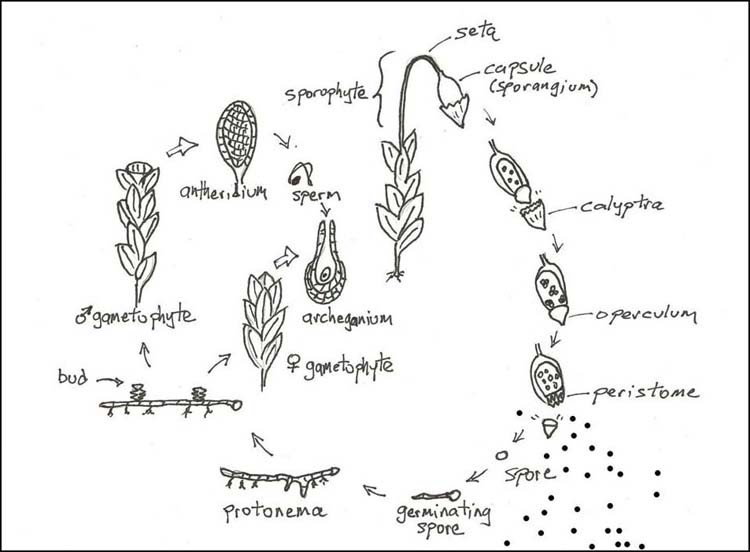
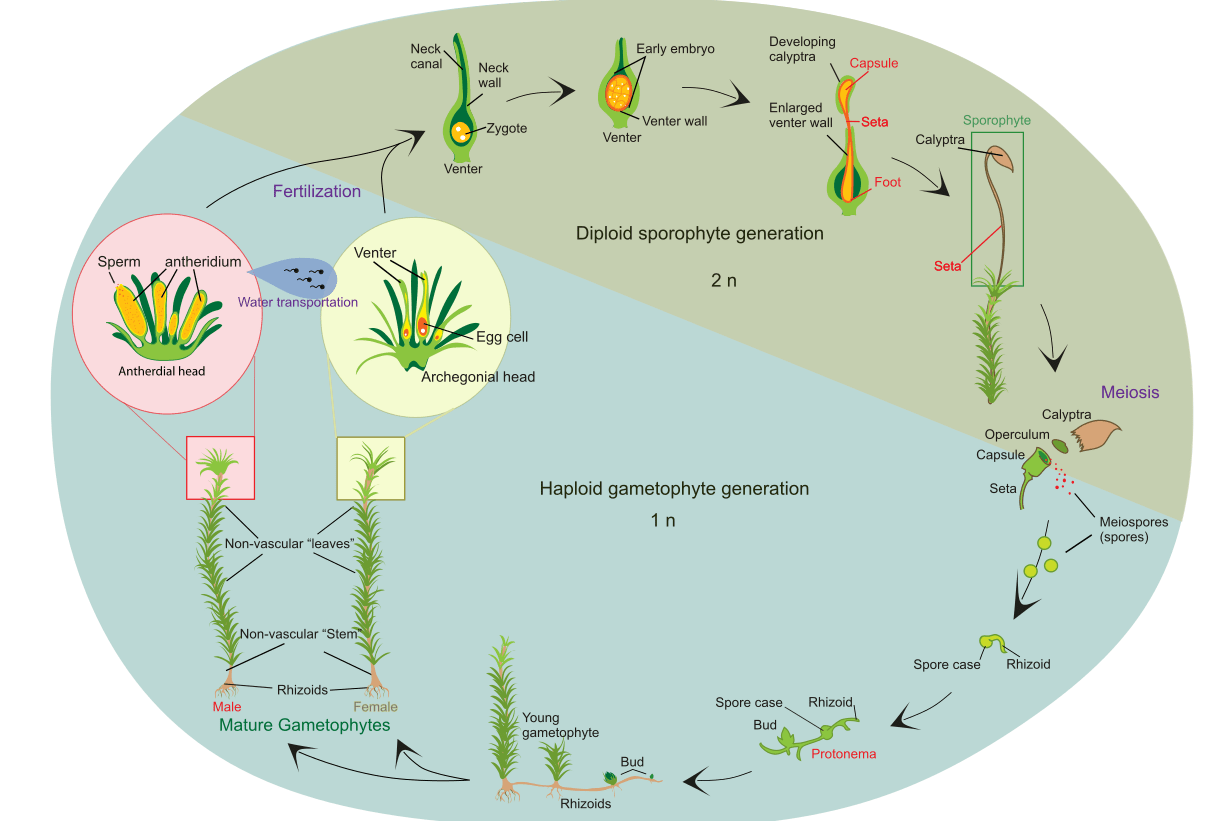
The calyptra develops from the wall of the old archegonium and so is actually a part of the gametophyte generation. It is responsible for the common name ("haircap moss") of this species. During the summer, each spore mother cell undergoes meiosis, producing four haploid spores — the start of the new gametophyte generation. Late in the summer, the calyptra and operculum become detached from the sporangium allowing the spores to be released. Find Diagram Showing Moss Life Cycle Illustration stock images in HD and millions of other royalty-free stock photos, illustrations and vectors in the Shutterstock collection. Thousands of new, high-quality pictures added every day. Use the preserved mount of the moss life history: can you identify the capsule, gametophyte generation, sporophyte generation, and operculum? Also look at microscope slides of moss antheridia, archegonia, and sperm. In your lab notebook, make a detailed diagram of the moss life cycle, labeling all key stages and structures.
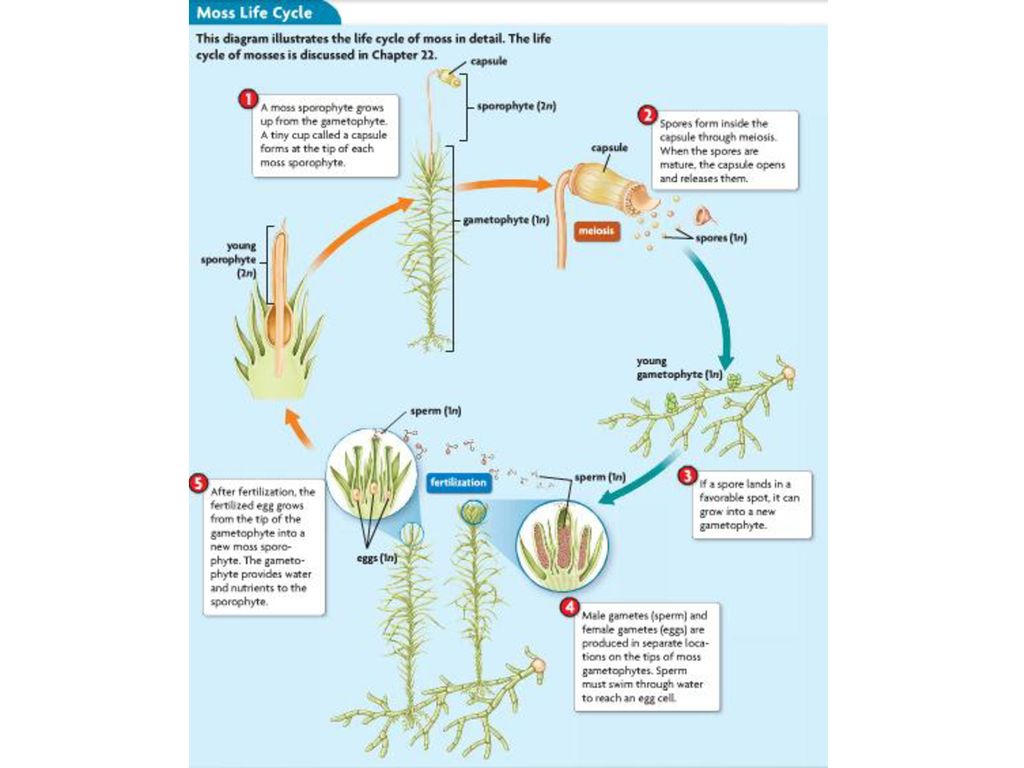
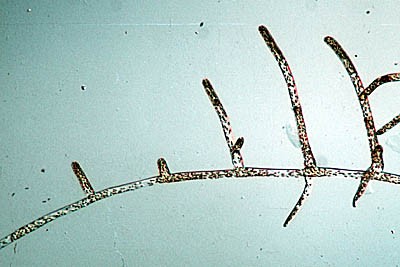
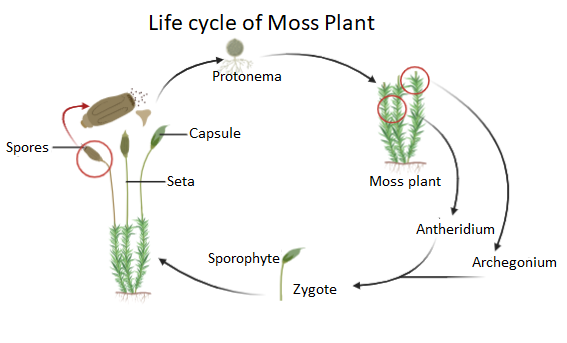
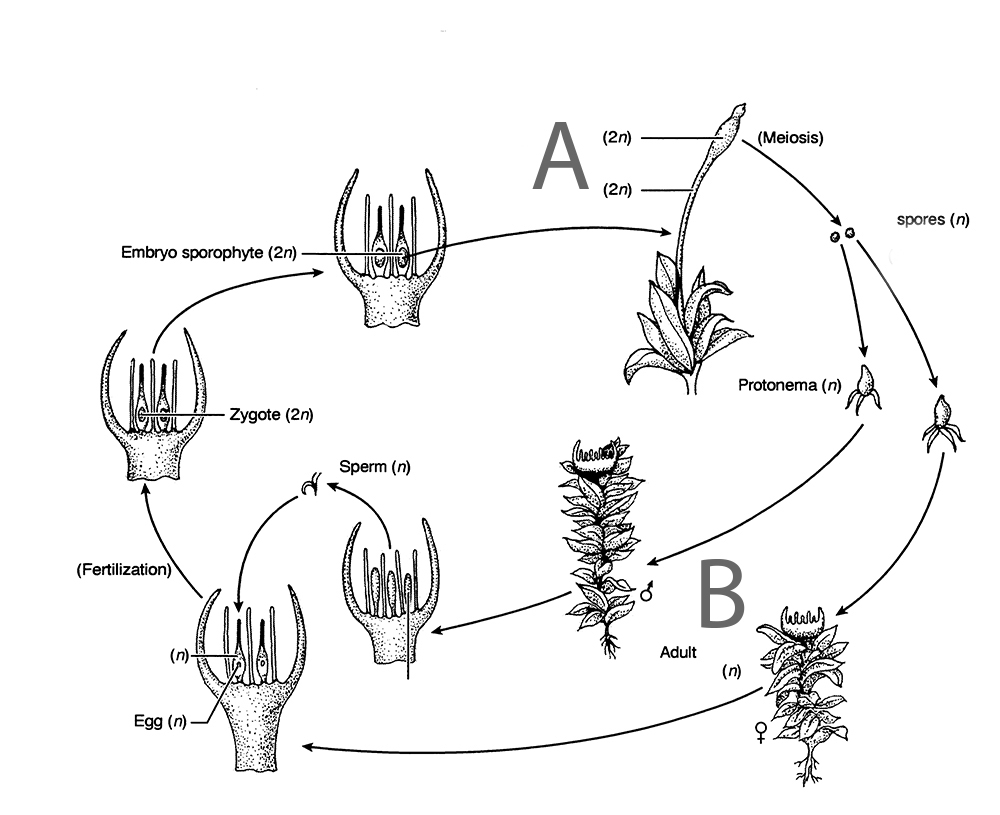
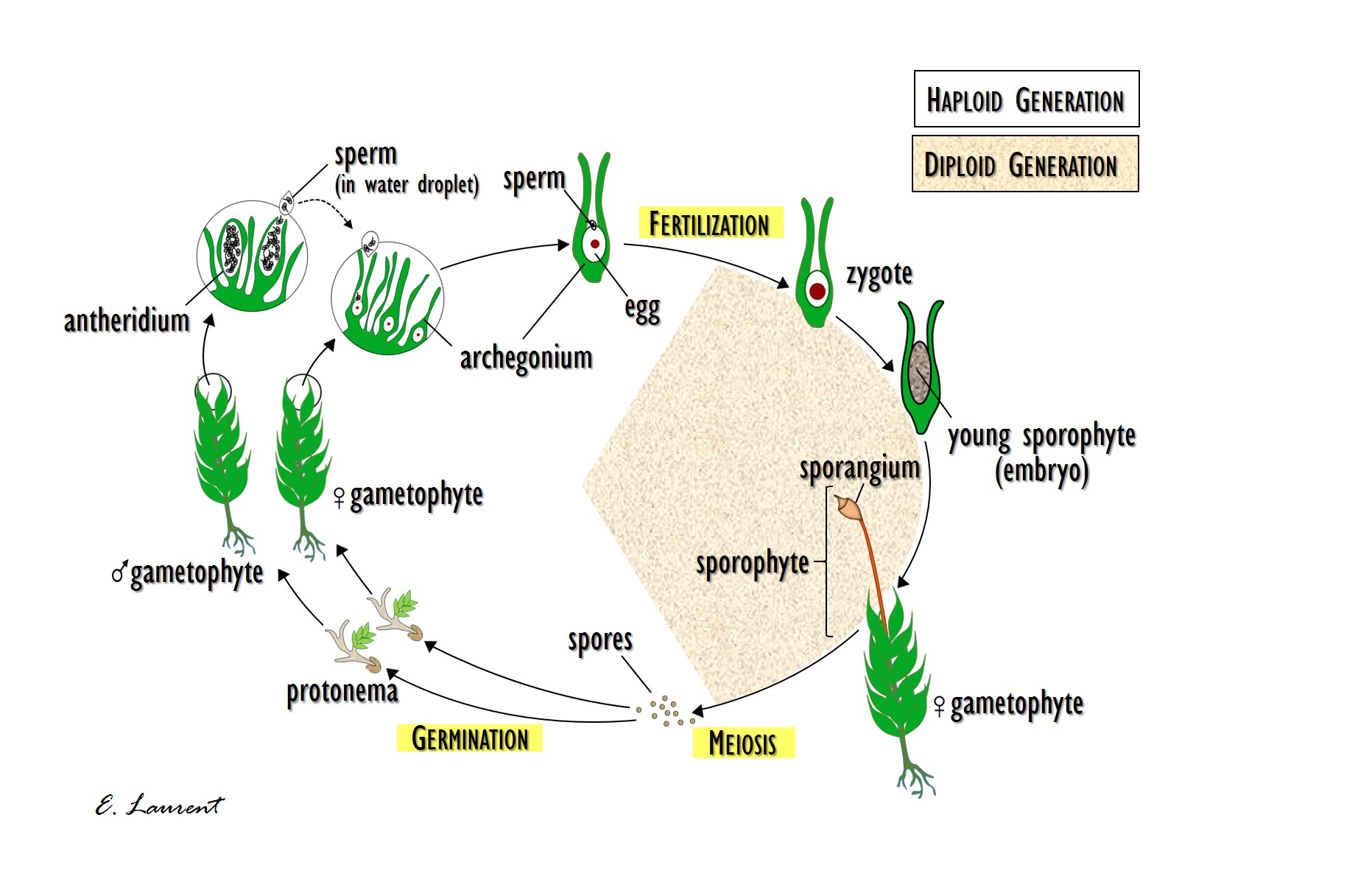
Moss life cycle diagram. Diagram - Moss Life Cycle Diagram is a high-resolution transparent PNG image. It is a very clean transparent background image and its resolution is 1280x751 , please mark the image source when quoting it. Review this diagram of the moss life cycle from the video. The moss life cycle consisting of 5 stages. The following structures are labeled clockwise: spores, gametophyte, egg, zygote, and sporophyte. The two labels indicate specific events in the life cycle. Fertilization is between the structures labeled egg and zygote. The life cycle of most mosses begins with the release of spores from a capsule, which opens when a small, lidlike structure, called the operculum, degenerates. A single spore germinates to form a branched, filamentous protonema, from which a leafy gametophyte develops. The gametophyte bears organs for sexual reproduction. The life cycle of mosses shows alternation of generation. They consist of only a single set of haploid chromosomes. The period when the moss plant has two paired chromosomes is known as the sporophyte stage. The life cycle starts with the sore, which is haploid and resulting in the production of protonema. Protonema is the thallus-like, flat ...
The term gametophyte might refer to the gametophyte phase of the plant life cycle or to the exacting plant body or organ that produces gametes. They are the most conspicuous part of the moss. For instance, most mosses have spirally arranged leaves that are one cell layer thick (unistratose). Illustration about Diagram showing moss life cycle illustration. Illustration of path, clipart, object - 101926901 Solution. The life cycle of most mosses begins with the release of spores from a capsule, which opens when a small, lidlike structure, called the operculum, degenerates. A single spore germinates to form a branched, filamentous protonema, from which a leafy gametophyte develops. The gametophyte bears organs for sexual reproduction. gametophyte for the entire life cycle. • The gametophyte is the leafy part. The sprophyte is the spore bearing part. • Used to be one phyllum (Bryophyta). Now three: Bryophyta (mosses), Hepatophyta (liverworts), and Anthoceraphyta (hornworts)
Moss Life Cycle Under The Microscope - YouTube ; A sporophyte ( / spɔːroʊˌfaɪt /) is the diploid multicellular stage in the life cycle of a plant or alga. It develops from the zygote produced when a haploid egg cell is fertilized by a haploid sperm and each sporophyte cell therefore has a double set of chromosomes, one set from each parent ... Download scientific diagram | Life cycle of moss [81] from publication: Contribution to the Moss Flora of Kizildağ (Isparta) National Park in Turkey | The ... Life Cycle of Mosses Like all plants, moss species show an alternation of generations , in which two different classes of individuals carry out separate parts of the reproductive process. In a system like this, one organism , the sporophyte , is a diploid organism which creates haploid spores through the process of meiosis . labelled diagram of Sporophyte of Moss. ... Moss is a non-vascular plant, meaning that it has no internal system to transport water. Sporophyte of Semibarbula or Moss: Zygote is the first cell of the sporophyte. The zygote (2n) divides, develops and eventually produces a sporophyte, called sporogonium. ... the life cycle of plants will be ...
Diagram - Moss Life Cycle Diagram PNG Image | Transparent PNG ...
The stage in the life cycle of a plant in which the plant prod…. Sporophyte. The stage in the life cycle of a plant in which the plant prod…. 15 Terms. briannasneyd1 PLUS. Typical Moss Life Cycle. Antheridium. Spores. Meiosis.

www.life cycle of a moss | Life cycles, Plant life cycle ...
The Moss Life Cycle Another example of the alternation of generations in plants: Print a Life Cycle Diagram - Click on this link and then use the browser print command to produce a diagram to use with the student tutorial.. Student Tutorial - Click on this link to learn more about the life cycle of the Moss.See pictures and diagrams of the organs associated with the gametophyte and sporophyte ...

Moss Life Cycle | Life cycles, Plant life cycle, Plant science
Moss Life Cycle. The mosses (and all bryophytes) have an alternation of generations life cycle that is unusual for two reasons: The haploid form is the dominant generation (larger, long-lived, and photosynthetic) The diploid form is the lesser generation (smaller, short lived and nutritionally dependent on the haploid form).

The Moss Life Cycle | Moss Gametophyte, Reproduction Parts & Diagram Video
The life-cycle of moss. Written by. Moss Lovers. in. Moss Facts. Moss reproduces in two ways: sexually and asexually. Moss sexually reproduces by transmitting sperm (in the presence of water) from the male plant to the female. The zygote forms a stalk (called seta) which hold spores in a small pod at its top. These spores are released when the ...

IXL | Moss and fern life cycles | 6th grade science
Illustration about Moss life cycle. Diagram of life cycle of Common haircap moss Polytrichum commune with titles. Illustration of calyptra, change, asexual - 120195744

Haplodiplontic: Moss life cycle Diagram | Quizlet
Study the moss life cycle diagram in Campbell Biology (fig. 29.6, 10th edition) and compare it to the specimens you see under the microscope. For each specimen you look at, make sure you can identify it as gametophyte (haploid) or sporophyte (diploid), and recognize where it belongs in the life cycle.

Diagram showing moss life cycle Royalty Free Vector Image
Diagram of life cycle of Common haircap moss (Polytrichum commune) with titles" can be used for personal and commercial purposes according to the conditions of the purchased Royalty-free license. The illustration is available for download in high resolution quality up to 5000x3520 and in EPS file format.
Solved] Name Type Here Date Type Here Concept Covered: Moss ...
Moss life cycle diagram: the red boxes show the male antherdial part while the blue boxes show the female archegonial part, both are required for sexual reproduction. Both of the mature...

Bryophyte life cycle diagram Diagram | Quizlet
Sep 13, 2018 · In the moss life cycle, fertilization takes place in the archegonium of the gametophyte. Mosses have diploid and haploid generations. Gametophytes, spores, sperm, and eggs are all haploid. Zygotes and their resulting sporophytes are diploid. Mosses can reproduce sexually or asexually.
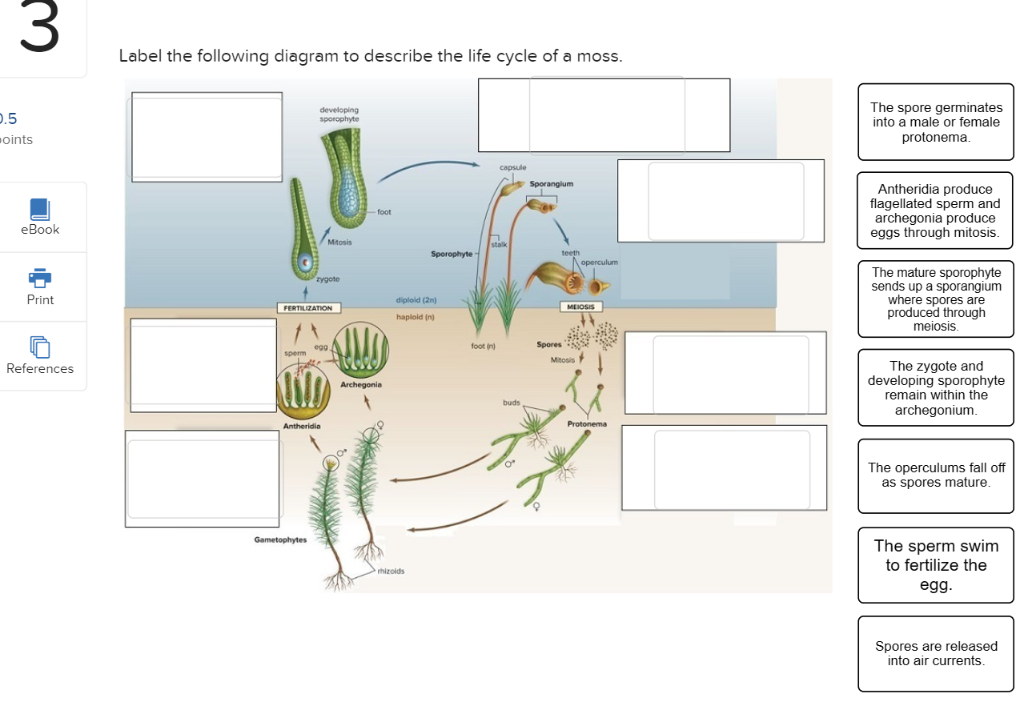
Solved 3 Label the following diagram to describe the life ...
Diagram of the alternation of generations life cycle Previously, we used the Garblinx to illustrate the oddity of this. Remember that the diploid or 2 N organism looks like this.
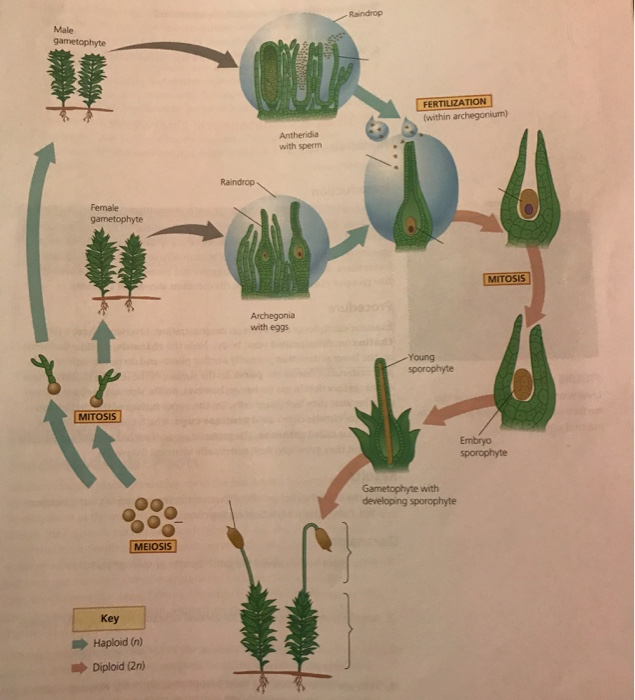
Solved Results 1. Review the structures and processes | Chegg.com
Bryophyte life cycle. The diagram above shows the life cycle of a typical moss. What you see growing on rocks at Kirstenbosch, or on damp walls on your house, is the gametophyte form of the moss plant. Sexual cells or gametes are formed by male and female gametophyte plants - and the male gamete or sperm needs water in which to swim towards ...

Plant Structure and Life Cycles
Life cycle of a moss. The familiar leafy moss plant is the sexual phase of the moss life cycle. When mature, most mosses develop sex organs . Some mosses have separate male and female plants, whereas others have male and female sex organs on the same plant. In wet conditions, sperm cells are released from male sex organs (antheridia) and swim ...
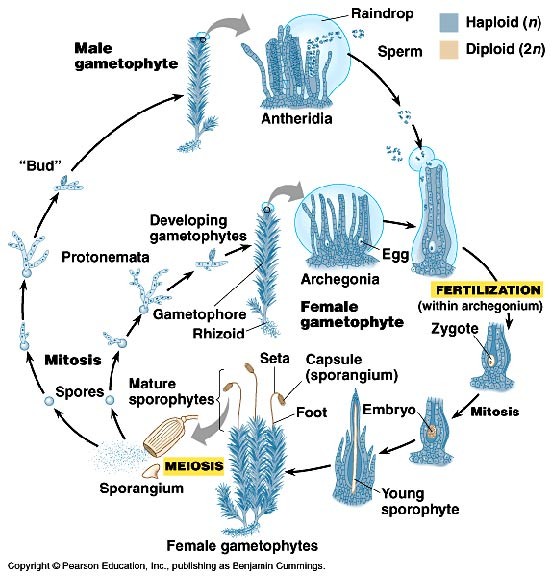
Moss Life Cycle - The University of Auckland
Moss Life Cycle ( musc = moss) These are terrestrial plants, but must live in very damp, shady places. They have no vascular system so must directly absorb water from the soil. Mosses have root-like rhizoids ( rhizo = root; -oid = like, form) and leaf-like structures, but these are not true roots/leaves because they have no vascular system.

Solved Label each structure in the moss life cycle. | Chegg.com
Download this Moss Life Cycle Diagram Of Life Cycle Of Common Haircap Moss With Titles vector illustration now. And search more of iStock's library of royalty-free vector art that features Moss graphics available for quick and easy download.
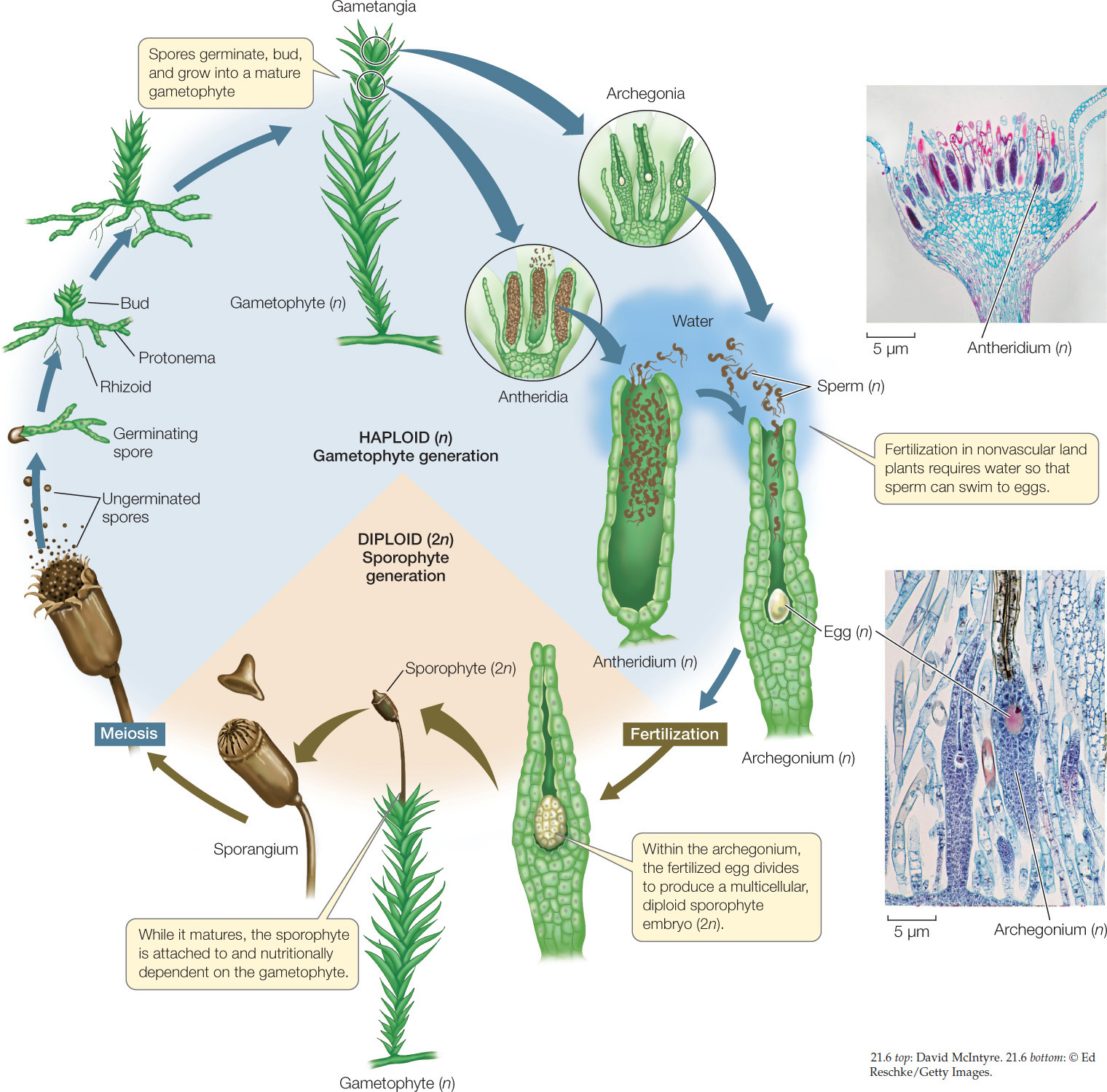
Figure 21.6
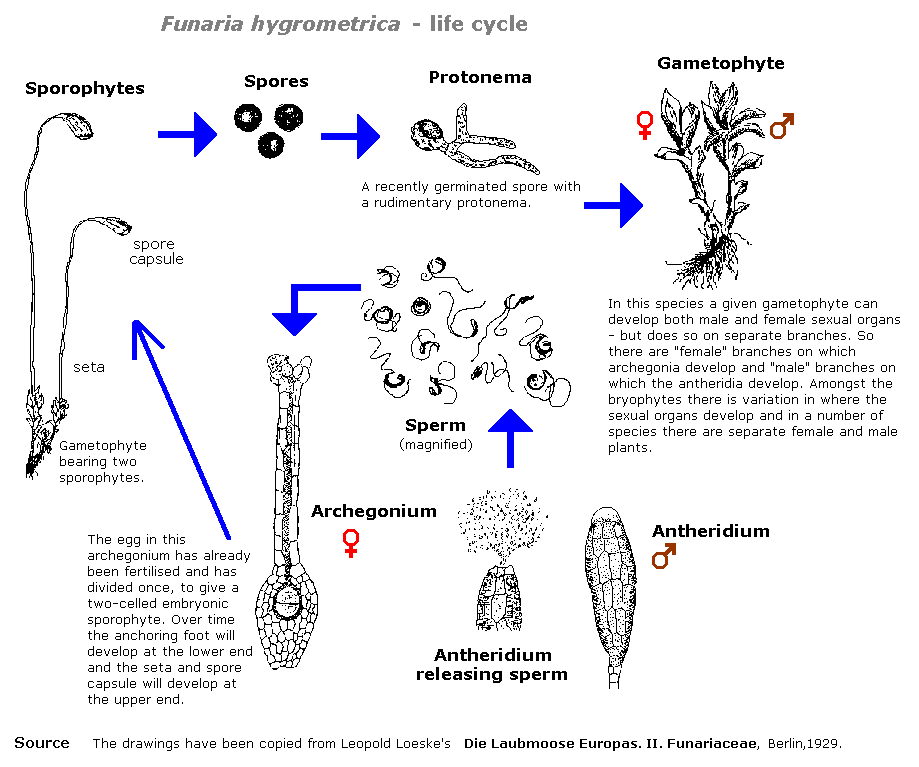
The following diagram gives one example of a bryophyte life cycle, that of the moss Funaria hygrometrica. Print this diagram as an A4 PDF. The spores produced in a spore capsule are the result of SEXUAL REPRODUCTION.
Life cycle of a modern bryophyte | Download Scientific Diagram
Use the preserved mount of the moss life history: can you identify the capsule, gametophyte generation, sporophyte generation, and operculum? Also look at microscope slides of moss antheridia, archegonia, and sperm. In your lab notebook, make a detailed diagram of the moss life cycle, labeling all key stages and structures.

Clipart of a Moss Life Cycle Diagram - Royalty Free Vector ...
Find Diagram Showing Moss Life Cycle Illustration stock images in HD and millions of other royalty-free stock photos, illustrations and vectors in the Shutterstock collection. Thousands of new, high-quality pictures added every day.
Moss Life Cycle. - ppt download
The calyptra develops from the wall of the old archegonium and so is actually a part of the gametophyte generation. It is responsible for the common name ("haircap moss") of this species. During the summer, each spore mother cell undergoes meiosis, producing four haploid spores — the start of the new gametophyte generation. Late in the summer, the calyptra and operculum become detached from the sporangium allowing the spores to be released.

The Moss Life Cycle | Moss Gametophyte, Reproduction Parts & Diagram Video

Moss Life Cycle Diagram Diagram | Quizlet
Moss Life Cycle - The University of Auckland

Garden Answers - Plant Identification App | Plant ...

AP Biology: Learn The Moss Life Cycle

Clubmoss Life Cycle Diagram Life Cycle Lycopodium Running ...

Moss Life Cycle (incomplete definitions) Diagram | Quizlet
Draw a diagram to describe the life cycle of the moss class ...
bryophytes-lifecycle – Ohio Plants

ImageQuiz: Life Cycle of Mosses (Bryophytes)

Life Cycle of a Moss - Infographic
![Life cycle of moss [81] | Download Scientific Diagram](https://www.researchgate.net/profile/Serhat-Ursavas/publication/268502605/figure/fig4/AS:310560966103053@1451054912988/Life-cycle-of-moss-81_Q640.jpg)
Life cycle of moss [81] | Download Scientific Diagram
2.3.2 Life cycle - LearningArcticBiology
template

Bryophyte (moss) Life Cycle Diagram Diagram | Quizlet
Moss life cycle | OER Commons
![Life cycle of moss [81] | Download Scientific Diagram](https://www.researchgate.net/profile/Felipe-Barberena/publication/274071069/figure/fig1/AS:391999292231686@1470471322937/Figura-1-Bertolonia-mosenii-Cogn-a-habito-b-flor-c-estame-d-bertolonidio-e_Q320.jpg)
Life cycle of moss [81] | Download Scientific Diagram

Animation: Moss Life Cycle
.jpg)
Moss Life Cycle - The University of Auckland

The life cycle of Moss

IXL | Moss and fern life cycles | 5th grade science
Life Cycle - in a nutshell - bryophyte
16.3B: Moss Life Cycle - Biology LibreTexts


Comments
Post a Comment