39 first class lever diagram
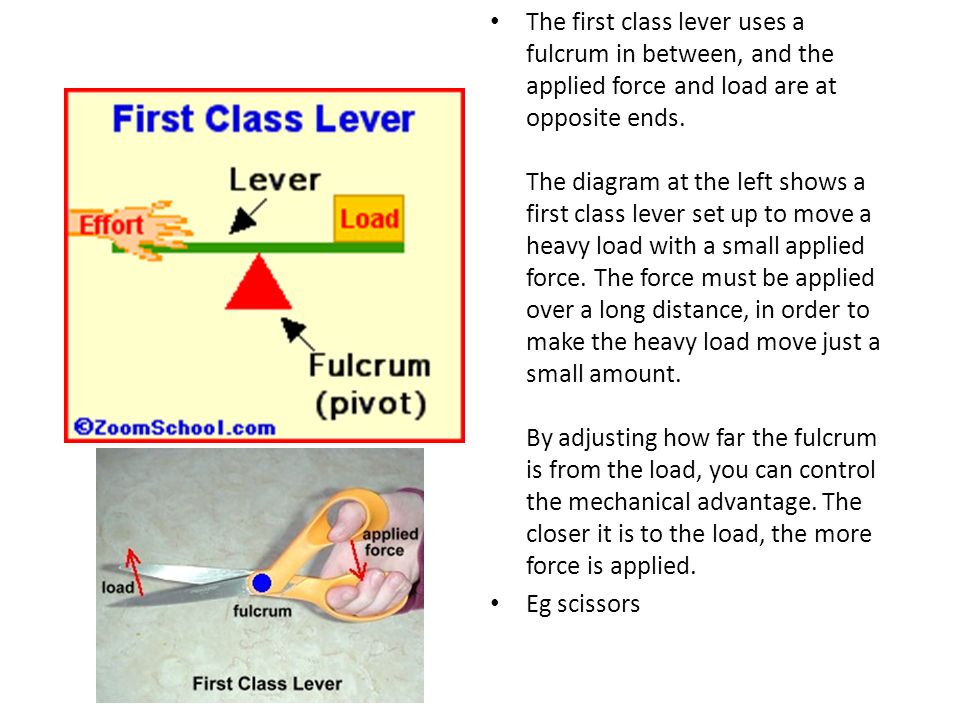
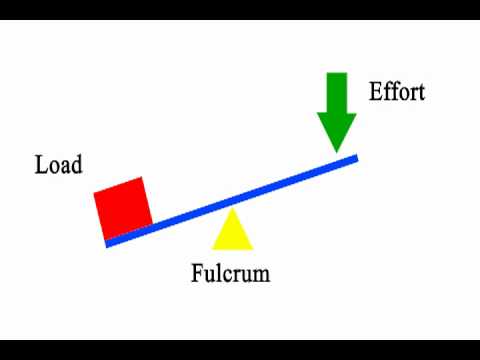
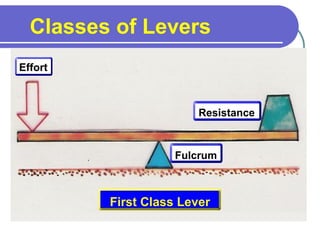
First Class Lever. Examples: • See-saw • Top of a Hammer to get out nails • Oars • Scissors. Lever Definition: a simple machine consisting of a bar that pivots at a fixed point, called a fulcrum. First Class Lever Definition: The fulcrum is located between the input force and the load. Mechanical Advantage: • MA will be equal to, greater First Class Lever - Displaying top 8 worksheets found for this concept.. Some of the worksheets for this concept are Levers, , Misp simple machineslevers work 2 l1 clever lever 3, Misp simple machineslevers work 1 l3 clever lever 1, Levers, Name simple machines work section 83, Simple machines, The 6 simple machines.
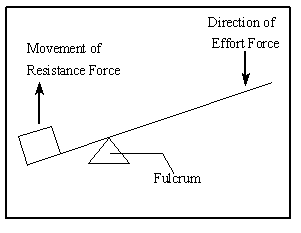
Diagram of the use of a first-class lever (blue) on a fulcrum (brown) A lever is a simple machine. It is something that can be used in a lot of ways. One way is by measuring things, or by seeing which weighs more. A lever is supported by a fulcrum which it uses to lifts weights. It is one of six simple machines.

First class lever diagram
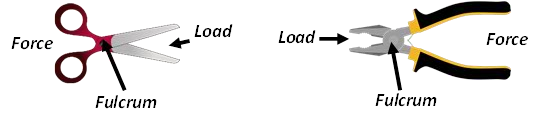
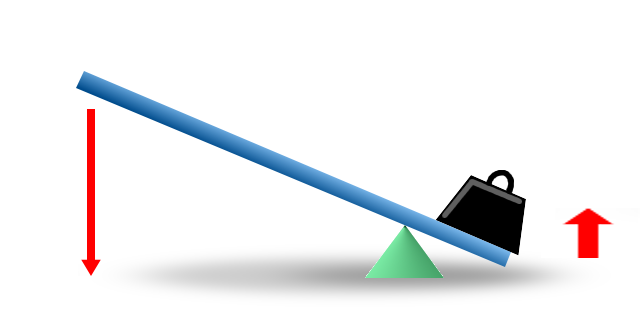
Get an answer for 'The diagram shows a first class lever. How far down will the effort side have to move to lift the load 1 m?' and find homework help for other Science questions at eNotes An anti-roll bar (roll bar, anti-sway bar, sway bar, stabilizer bar) is a part of many automobile suspensions that helps reduce the body roll of a vehicle during fast cornering or over road irregularities. It connects opposite (left/right) wheels together through short lever arms linked by a torsion spring.A sway bar increases the suspension's roll stiffness—its resistance to roll in … A first-class lever has the axis (fulcrum) located between the weight (resistance) and the force (figure 1.21a). An example of a first-class lever is a pair of pliers or scissors. First-class levers in the human body are rare. One example is the joint between the head and the first vertebra (the atlantooccipital joint) (figure 1.21b).
First class lever diagram. A lever is a rigid object used to make it easier to move a large load a short distance or a small load a large distance. There are three classes of levers, and all three classes are present in the body [2] [3]. For example, the forearm is a 3rd class lever because the biceps pulls on the forearm between the joint (fulcrum) and the ball (load). In a first class lever, the fulcrum is located between the load and the effort. In a first class lever, the fulcrum is located between the load and the effort. When the fulcrum is closer to the load, then less effort is needed to move the load (©2020 Let's Talk Science). ... This book contains examples of control circuits, motor starting switches, and wiring diagrams for ac manual starters, drum switches, starters, contactors, … Apr 17, 2020 · A first-class lever, in which the fulcrum is between the load and the effort, can aid in work by changing the direction of the force and by increasing the efficiency or mechanical advantage of the force applied. The force exerted on a first-class lever has greater mechanical advantage proportional to its distance from the fulcrum. . According to Ohio University, a lever is a ...
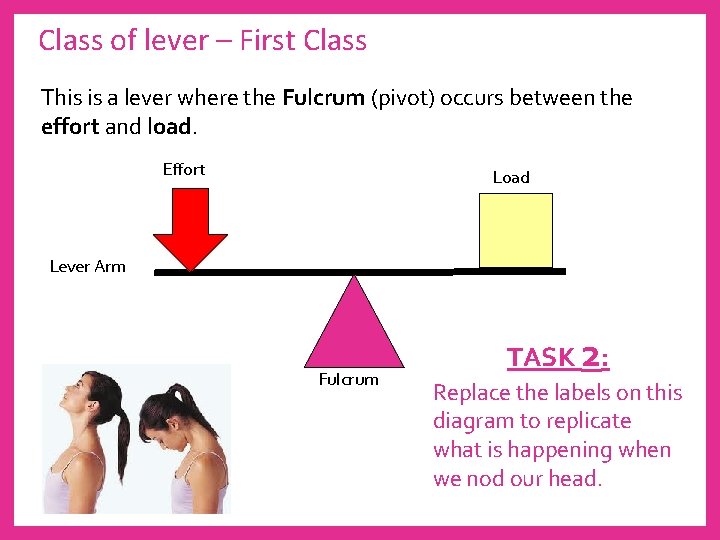
The first class lever is one of three classes of levers and is one possible arrangement of muscles, bones, and joints found in the human body. While less common in the body than second and third class levers, the first class lever system is found in the neck at the atlanto-occipital joint and in the elbow joint. Anatomy Lesson Description BioNetwork’s Virtual Microscope is the first fully interactive 3D scope - it’s a great practice tool to prepare you for working in a science lab. Explore topics on usage, care, terminology and then interact with a fully functional, virtual microscope. When you are ready, challenge your knowledge in the testing section to see what you have learned. The mechanical advantage of a lever is the ratio of the load the lever overcomes and the effort a person or system applies to the lever to overcome some load or resistance. In simple words and as per the formula, it's the ratio of load and effort. The formula of the mechanical advantage(MA) of a lever is given as MA = load/effort. Another form of this ma formula is MA = Effort Arm/Load Arm ... A traditional landline telephone system, also known as plain old telephone service (POTS), commonly carries both control and audio signals on the same twisted pair (C in diagram) of insulated wires, the telephone line. The control and signaling equipment consists of three components, the ringer, the hookswitch, and a dial. The ringer, or beeper, light, or other device …
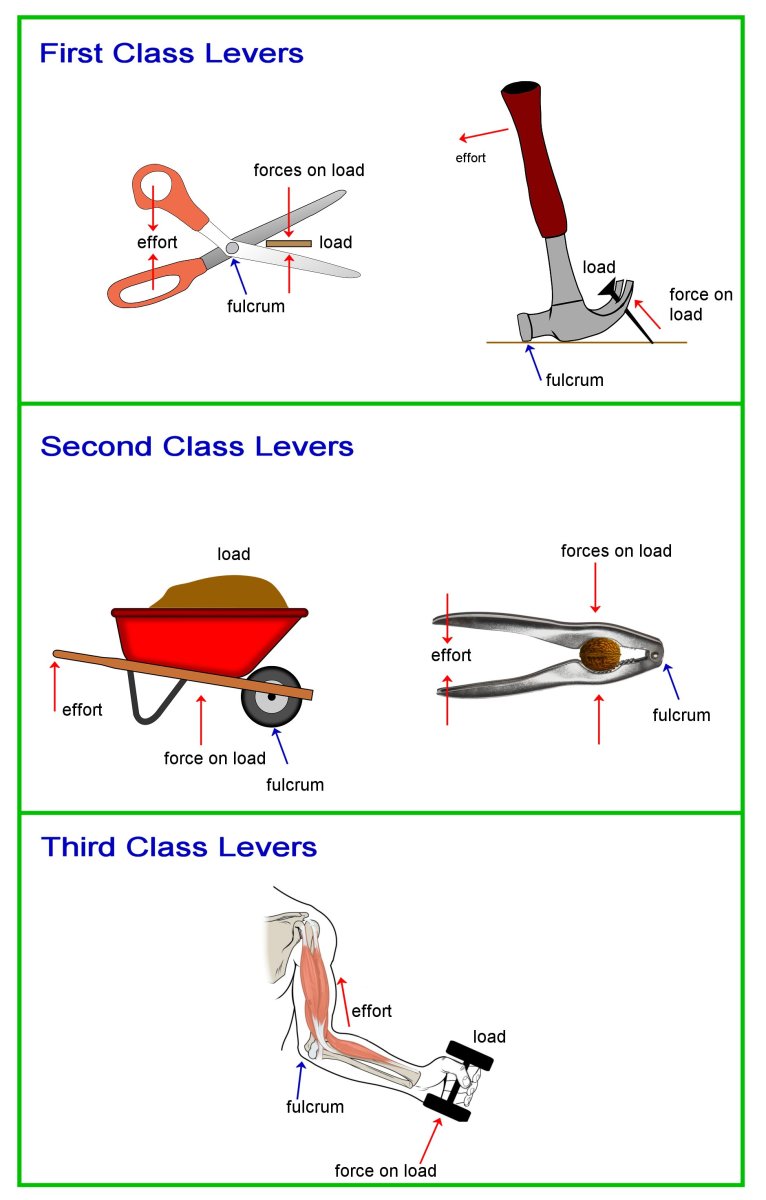
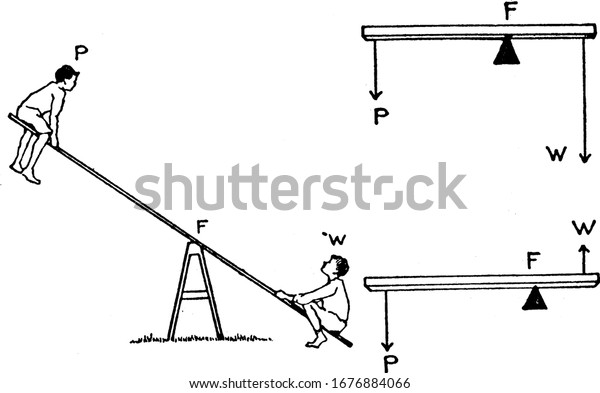
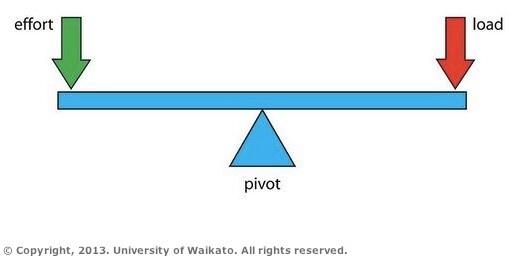
First Class Lever. This is a type of lever which has the fulcrum in between the weight and the force applied. Its order is represented as force-fulcrum-weight. This is the most basic type of lever. Examples. Our hand pushing an object or seesaws, crowbars. Using scissors represents the use of two first-class levers. A wheel and axle is also an ... The first-class lever is illustrated in Figure 1. Second-class levers have the load between the effort and the fulcrum. A wheelbarrow is a second class lever. The wheel is the fulcrum, the handles... First class lever This type of lever is found in the neck when raising your head to head a football. The neck muscles provide the effort, the neck is the fulcrum, and the weight of the head is the... Jun 21, 2007 · Published 21 June 2007 Size: 16 KB Referencing Hub media. Different classes of levers are identified by the way the joint and muscles attached to the bone are arranged. For the Class 1 lever the pivot lies between the effort and load. A see saw in a playground is an example of a Class 1 lever where the effort balances the load.
OTR 313 - Second Class Lever Diagram | Quizlet
First-class lever system In a first-class lever, the fulcrum is the middle component and lies between the effort and load. Examples of a first-class lever in the body are rare as few exercises utilise a first-class lever system although extension (straightening) at the elbow is one example.

Pin by Rachel Thompson on pta | Lever image, Muscle system ...
The image below is an example of a Class One Lever, sometimes called a First Class Lever. Examples of Class One Lever: All classes of levers have four basic parts: Beam- The lever, a wooden plank or metal bar resting on the fulcrum. Fulcrum- the pivot or the turning point.

The diagram shows a first class lever. How far down will the ...
A lever mechanism where the input effort is higher than than the output load is often characterized as a third-class lever mechanism. Example - Third-Class (Order) Lever. A force (weight) of 1 pound is exerted at a distance of 2 ft from the fulcrum. The effort force at a distance of 1 ft from the fulcrum can be calculated as. F e = F l d l / d ...

Diagram of three classes of levers | Science lessons, Basic ...
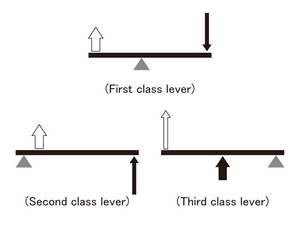
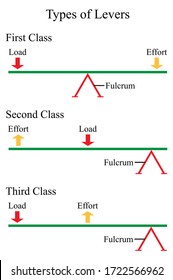
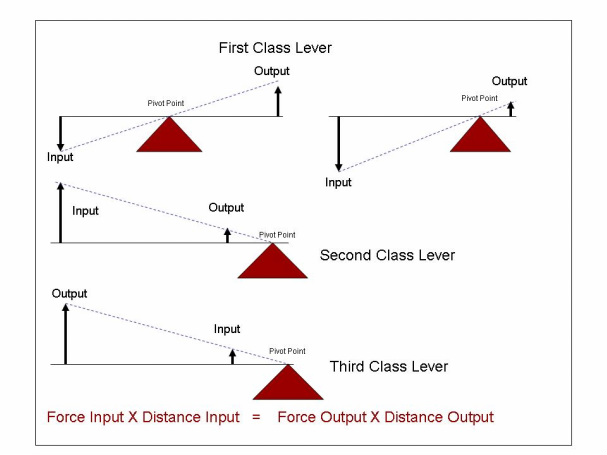
The three types of levers are as follows: (1) First Class lever or class I lever, (2) Second Class lever or class II lever, and. (3) Third Class lever or class III lever. These types are based on the relative position of the fulcrum, load, and effort in the lever body.
Nagoya City Science Museum Website | Exhibition Guide | Floor ...
4.12.2019 · ICSE Solutions for Class 10 Physics – Force, Work, Power and Energy. ... The electric energy first changes to heat and finally to light energy. ... Question 2: A man can open a nut by applying a force of 150 N by using a lever handle of length 0.4 m.

16 Diagram Of A Simple Lever Illustrations & Clip Art - iStock
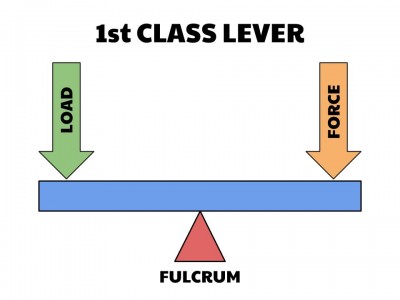
This model shows a first class lever. It has the effort and load at opposite ends with the pivot in between. This model uses the least effort to move the load. A2 This model shows a second class lever. It has the effort and pivot at opposite ends and the load in between. The effort needed to move the load is about half the load force.
Unit 12 Competency 2 - Examine and classify levers ...
First Class Lever. The effort is on one side of the lever and the load is on the other side. The fulcrum is in the middle. ... How Levers Work - The Physics. In the diagram below, two forces act on the lever. This is a schematic or diagram, but it symbolically represents any of the real life levers mentioned above.
Class One Lever Examples
“First Class Lever” • A first-class lever is a lever in which the fulcrum is located between the input effort and the output load. • In operation, a force is applied (by pulling or pushing) to a section of the bar, which causes the lever to swing about the fulcrum, overcoming the resistance force on the opposite side. Examples:
First class lever Images, Stock Photos & Vectors | Shutterstock
Example of a first-class lever in the human body: An example is the neck as it shifts from a position of flexion (such as when a person is looking straight ahead) to a position of extension (such as when a person is looking up). The contraction of the trapezius muscle permits extension of the head. Second Class Lever Diagram of a second-class ...

Classes of Lever
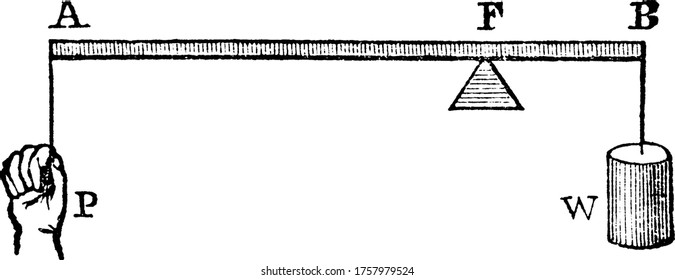
A first-class lever is a beam, rod or stick with the load at one end, the fulcrum in the middle and the force applied on the other end. A good example of a first-class lever is a child’s see-saw. Levers are simple machines — apparatuses composed of few or no moving parts that make performing a task easier by one or more of four methods:

Three Lever Classes by Ron Kurtus - Succeed in Understanding ...
General. Question #85010. Click on the diagram that shows a first-class lever. General. 1453 students attemted this question. Bookmark. Add Comment. Share With Friends. Report.
How do levers create energy if the conservation of energy ...
One of the most common uses of a lever in our everyday life is in using a hammer or scissors. These are classified by scientists as first class levers (see Diagram 4). When using a hammer to pull a nail out of a wall, or piece of wood, it is acting as a lever. The claw of the hammer is acting as the load because it has the head of the nail in it.
Unit 12 Competency 2 - Examine and classify levers ...
First-class lever. Fulcrum in the middle (looking up, or triceps extension) Second-class lever. Resistance in the middle (tip toes) Third-class lever. Effort in the middle (bicep curl or kicking a ball) *most common in human body & sport. Mechanical advantage of 1st & 2nd class levers.
lever diagram
First Class lever. fulcrum in the middle between the effort force and the resistance arm. Lever-A beam on a fulcrum-Smaller force can move more weight. First class lever examples. Scissors, Can opener. Second Class lever. The load is between the fulcrum and the effort force.
Simple Machines: How Does a Lever Work? - Owlcation
Levers -The Basics - The human body is made up of levers, and these work together to create movement. There are three types of levers you need to understand:-1st class levers -Fulcrum in the middle-2nd class levers -Load in the middle-3rd class levers -Effort in the middleEvery lever is made up of three parts:
Basic Biomechanics: Levers
Class three levers have the load on one end of the post, the fulcrum on the opposite end, and the effort is applied to the middle as shown in diagram 3. A fishing pole or tweezers or your forearm are good examples of class three levers. The effort force applied to a lever can be calculated by a simple formula: F l x d l = F e x d e F l x d l
First Class Levers
Powered by FlexBook® textbook Platform ® © CK-12 Foundation 2022; Please wait... Please wait...
UNDERSTANDING LEVERS
A first-class lever has the axis (fulcrum) located between the weight (resistance) and the force (figure 1.21a). An example of a first-class lever is a pair of pliers or scissors. First-class levers in the human body are rare. One example is the joint between the head and the first vertebra (the atlantooccipital joint) (figure 1.21b).

Levers
An anti-roll bar (roll bar, anti-sway bar, sway bar, stabilizer bar) is a part of many automobile suspensions that helps reduce the body roll of a vehicle during fast cornering or over road irregularities. It connects opposite (left/right) wheels together through short lever arms linked by a torsion spring.A sway bar increases the suspension's roll stiffness—its resistance to roll in …

Examples of a Second-Class Lever | Download Scientific Diagram
Get an answer for 'The diagram shows a first class lever. How far down will the effort side have to move to lift the load 1 m?' and find homework help for other Science questions at eNotes
UNDERSTANDING LEVERS
There are three types of levers, identified as first class ...
What are examples of 1st, 2nd, and 3rd class levers in the ...
First class lever Images, Stock Photos & Vectors | Shutterstock

Lever Systems In Biomechanics - 1st Class, 2nd Class, 3rd ...
First Class Lever
Levers in the Human Body
Pivot diagram of a Class 1 lever — Science Learning Hub
2 1 Lever systems examples of their use
1st Class Lever.avi - YouTube
First class lever Images, Stock Photos & Vectors | Shutterstock

Lever Systems In Biomechanics - 1st Class, 2nd Class, 3rd ...
Levers

LEVER AND ITS TYPES WITH EXAMPLES - UNDERSTANDING BUSINESS ...
Levers and mechanical advantage

Click on the diagram that shows a first class lever - Brainly.com

Lever Systems In Biomechanics - 1st Class, 2nd Class, 3rd ...

In a first-class lever, the fulcrum is in the middle of the ...

2nd Class Lever Video


Comments
Post a Comment